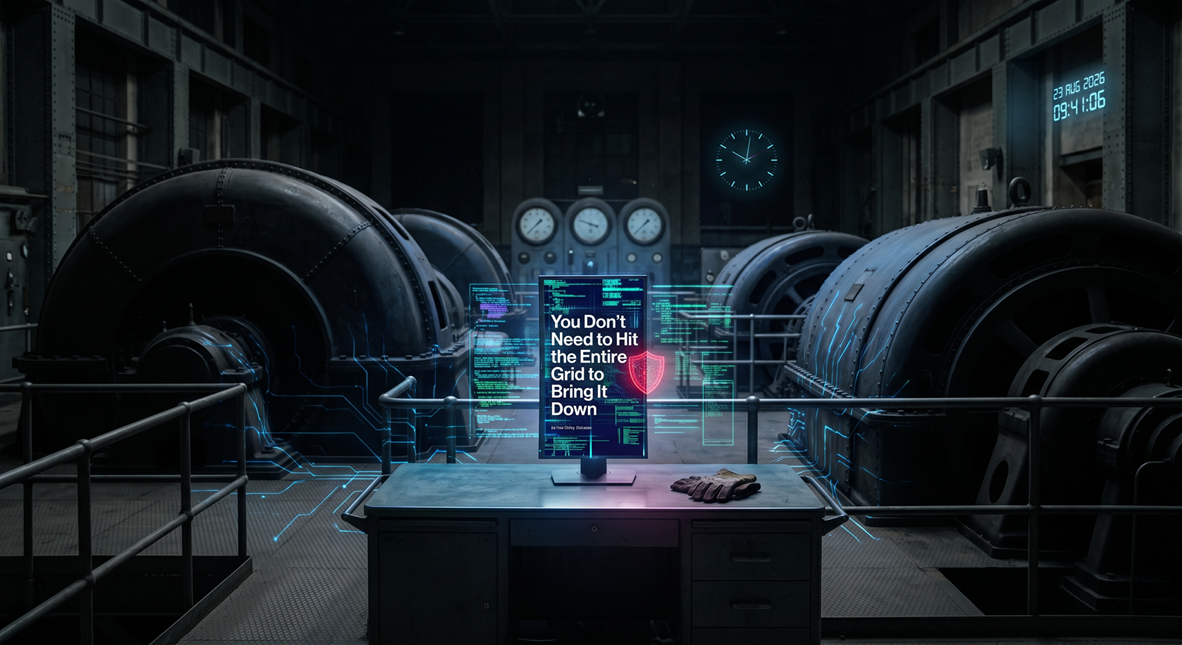
A 92% Probability of a Major Battery Attack. Why the Real Danger Is Right Now.
Security
A study by risk analysis firm Centrii recently put a startling number to a quiet vulnerability: under baseline industry practices, there is a 92% probability of a catastrophic cyberattack targeting Battery Energy Storage Systems (BESS) within the next five years.
Headlines citing a multi-year window give the impression that this is a risk for the distant horizon.
It is not.
The study models the cumulative risk between now and 2031, but the physical exposure, network connectivity, and systemic dependencies are fully operational today. The conditions needed to trigger a blackout using energy storage assets are already embedded in the grid.
The New Attack Vector: Weaponizing the Balancing Layer
Historically, cyber threats to power companies revolved around stolen corporate data, ransomware on IT servers, or isolated substation outages.
A coordinated battery attack operates on an entirely different scale. It does not need to destroy physical hardware, cause fires, or shut down massive power plants.
It only needs to desynchronize the balancing layer.
Grid-scale batteries act as the shock absorbers of modern power networks. They respond in fractions of a second to smooth out intermittent renewable power and maintain steady frequency. Because of their speed, manipulating how they behave across multiple locations simultaneously functions like a physical denial-of-service attack on the grid itself.
By forcing batteries to charge or dump power simultaneously, or artificially delaying their response to frequency drops, an adversary overwhelms the system's ability to maintain equilibrium. The modeled result is a cascading blackout unfolding in under two minutes:
• In the UK: Compromising just 29% of national battery capacity (around 400 units) is enough to cause a nationwide outage affecting 67 million people and inflicting up to £10 billion in economic fallout.
• In Texas (ERCOT): Compromising just 5.4% of the battery fleet (about 1,500 units) could destabilize the entire grid, impacting 30 million people with economic damages reaching between $12 billion and $65 billion.
Why the Exposure Is Present Today
Waiting to address this risk assumes attackers need years to build capabilities. In reality, the vulnerability is active right now:
• Centralized Remote Management: Utility-scale batteries are almost universally tethered to vendor portals, cloud diagnostics, and aggregator platforms for maintenance and market dispatch. Gaining access to a single management layer gives an attacker leverage over dozens of distributed sites at once.
• Rapid Deployment vs. Operational Visibility: Batteries have deployed at breakneck speed to keep pace with the energy transition. Most operational environments simply lack the tools to see what these devices are doing in real time, leaving security teams blind to whether an asset's behavior reflects normal market participation or an unauthorized override.
• Active Infiltration: Critical infrastructure is already subject to persistent reconnaissance. Threat actors are mapping assets, testing entry paths, and identifying control systems today.
The Regulatory Fragment: Why Checklists Fall Short
Regulatory bodies worldwide are working to establish guardrails. In North America, NERC CIP frameworks are racing to close gaps around distributed and inverter-based assets. In Europe, the NIS2 Directive imposes strict operational resilience and personal accountability on executives across essential energy entities.
Beyond these, a complex web of state, national, and regional mandates is rapidly emerging:
• State-level utility commission mandates across the US enforcing supply chain and operational controls.
• National cybersecurity directives across the EU, the UK, Australia, and APAC targeting distributed energy resources (DERs).
• Grid code amendments demanding demonstrable cyber resilience before interconnection.
While these frameworks set necessary baselines, compliance alone is not resilience. Checklists are inherently reactive. Meeting compliance requirements on paper does not stop a coordinated, automated intrusion in the field.
More importantly, navigating this patchwork of evolving global standards creates massive administrative strain for utility teams, pulling scarce operational focus away from actively protecting the grid.
The Operational Solution: Bridging the Resource and Context Gap
The fundamental challenge in grid cybersecurity is not an awareness problem; it is a resource and visibility problem.
Most utilities and operators face a severe shortage of dedicated operational technology (OT) cybersecurity specialists. When security teams do evaluate grid alerts, traditional enterprise tools lack electrical context. A network anomaly means nothing if an operator cannot instantly tell whether it threatens grid stability or violates a regional standard.
Closing this exposure today requires a fundamentally different approach:
1. Unifying Cyber Telemetry with Electrical Context: It is no longer enough to look at network traffic in isolation. Operators must continuously monitor their environments with full operational awareness, directly linking communication anomalies to real-world grid impact and active power swings.
2. Automating the Heavy Lift: Relying on disconnected toolsets, manual audits, and external consultants is too slow and too expensive. The industry requires modern, automated platforms that continuously track both passive and active network activity while automating compliance workflows across shifting regional frameworks.
3. Translating Risk into Operational Action: When an anomaly appears, control rooms need immediate, actionable intelligence that tells them what physical equipment is affected, the operational consequence to the local grid, and the exact steps needed to isolate the threat before it cascades.
The study proves that proactive defense works, significantly lowering the probability of an attack and preserving grid stability. But resilience cannot remain a distant line item.
The batteries are connected. The dependencies are real. The time to secure the balancing layer is not down the road - it is now.